EU policy changes can both raise and reduce business costs, affecting competitiveness through compliance, labour, sustainability, and trade rules. Businesses should assess relevant rules, anticipate costs and opportunities from simplification, and adjust strategies for productivity and market access.
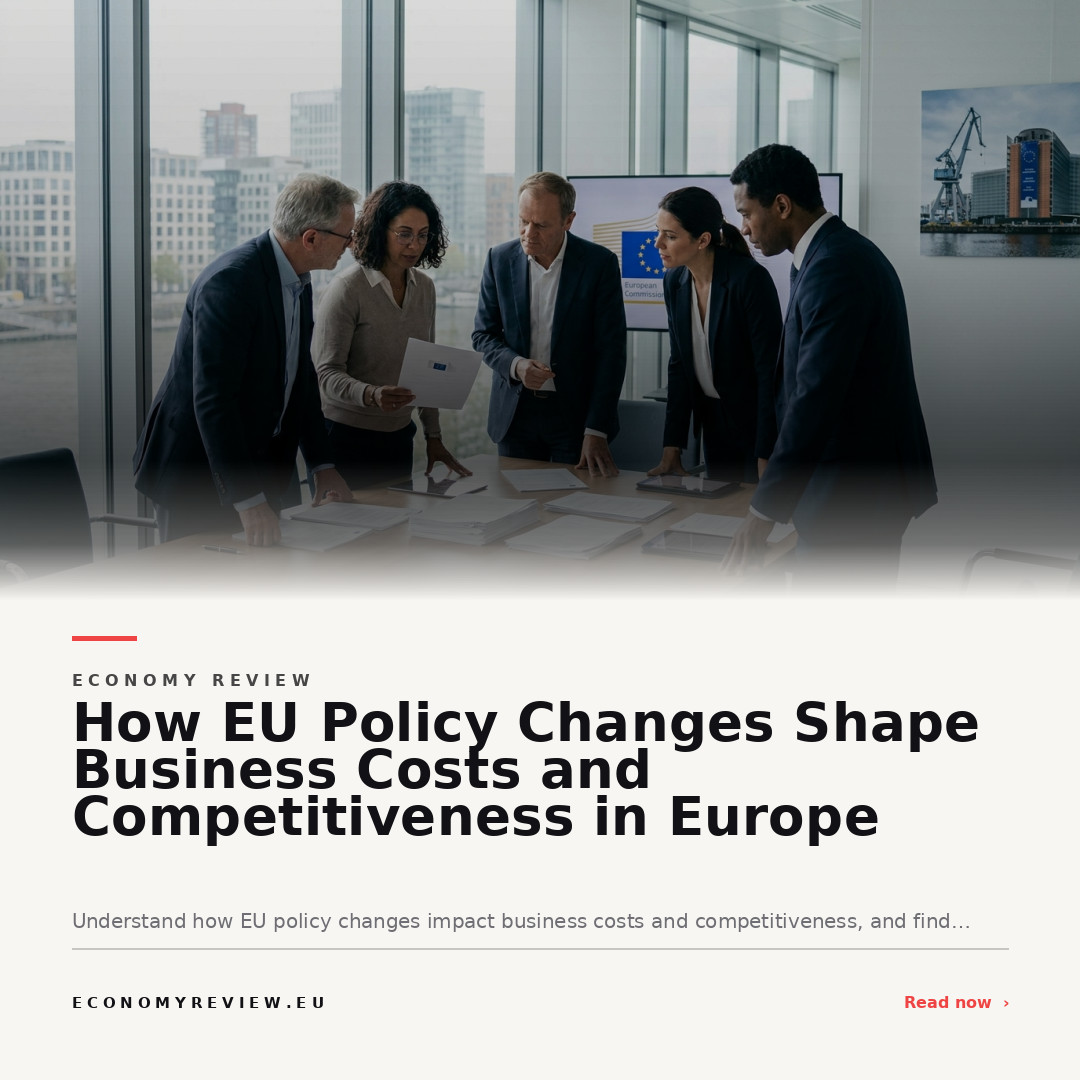
EU policy changes have a direct and significant influence on business costs and competitive positioning across Europe. Regulatory updates, whether through new compliance obligations, labour frameworks, or sustainability mandates, can increase expenses for firms; yet, policy-driven simplifications and Single Market integration create substantial savings and new opportunities. For business leaders, understanding both sides is crucial for informed planning and sustained competitiveness in a fast-evolving regulatory environment.
- Policy changes can increase or decrease costs via compliance, labour, or sustainability rules.
- Administrative simplification aims to reduce burdens, especially for SMEs.
- Market access and productivity are directly shaped by Single Market policies.
- Impacts vary widely by company size, sector, and Member State.
- Structured impact assessment is essential for business preparedness.
How do EU policy changes affect business costs and competitiveness?
EU policy changes affect business costs and competitiveness primarily by introducing new requirements or by reducing existing administrative burdens. When the European Union updates its regulatory framework—whether on data protection, labour, corporate sustainability or cross-border trade—it can make compliance easier or more complex. This shapes operating costs and can tilt competitive balance between companies that adapt early and others left behind. Persistent barriers in the Single Market, such as complicated cross-border establishment and fragmented product regulations, often increase compliance costs and reduce opportunities for firms to compete effectively across borders.
Where can business costs rise? Compliance, labour, sustainability, and trade rules
Costs tend to rise when companies face new or expanded compliance obligations. Examples include enhanced sustainability reporting, stricter labour posting rules, and requirements for supply-chain due diligence. Between 2014 and 2023, compliance costs for EU firms nearly doubled, with excessive regulatory and administrative burdens deterring new entrants and lowering productivity. Fast-changing legislation and complex administrative procedures are repeatedly cited by business as top obstacles to investment [5]. National differences in company law and the way rules like professional qualification recognition are implemented also compound operational friction and costs. For sustainability rules, businesses must continuously adjust to evolving standards, while upcoming carbon border adjustment mechanisms (CBAM) or digital market regulations may shift both sectoral costs and competitive dynamics.


Where can costs fall? Simplification, digital processes, and shared EU rules
EU policy increasingly aims at reducing administrative burdens by harmonising and simplifying rules. The European Commission’s current agenda targets a 25% reduction in administrative burdens overall, with SMEs benefiting from at least a 35% reduction [2]. Projected annual savings could reach €37.5 billion by 2029, supporting reallocation of resources from paperwork to investment and innovation. Reforms, such as the Council’s 2026 decision to simplify sustainability reporting—delaying deadlines, narrowing the scope to only the largest firms, capping penalties—illustrate how targeted simplification reduces compliance workload. Omnibus simplification measures are projected to yield substantial gains, but businesses should monitor which proposals are enacted, as not all savings are immediate or universally applied [2].
How does the Single Market drive market access and productivity?
The Single Market is a core driver of business productivity and access to customers. By harmonising product and service rules, eliminating customs checks, and enabling talent mobility, it has raised EU GDP by an estimated 3–4% each year and created over 3.5 million jobs so far. However, integration has plateaued, and intra-EU trade in goods declined in 2024, partly due to lingering regulatory fragmentation. Fragmented national implementation of harmonised rules still causes uncertainty and administrative overhead, particularly for firms operating in multiple Member States. Addressing these gaps and further simplifying cross-border procedures is key for enhancing both productivity and competitiveness at EU-level.
Why do impacts differ by company size, sector, and Member State?
The effect of EU regulatory changes is not uniform. SMEs often bear a disproportionately high burden from compliance due to limited resources for legal and administrative support. Sector-specific regulations, such as those in chemicals, digital, or energy, may impose higher costs or deeper reporting obligations than in less regulated industries. Moreover, national implementation can add complexity: Member States sometimes add “gold-plating”—going beyond EU minimum standards—or delay transposition, causing competitive distortions and cost disparities. Businesses in countries with more efficient administrative systems or proactive adaptation mechanisms tend to experience lower costs and greater agility [5].
Typische Probleme
One frequent problem is fragmentation—when national interpretations of EU directives diverge or are delayed, businesses must navigate multiple administrative systems, creating uncertainty and additional costs. Another challenge is the fast pace of legislative change, making it difficult for firms to plan investments or to upskill staff in time [5]. SMEs are especially vulnerable, lacking the resources for ongoing monitoring and adaptation, and often find themselves disproportionately affected by both cost increases and compliance uncertainty.
Aktuelle Entwicklungen
Recent policy moves include the Council’s approval (February 24, 2026) of streamlined sustainability rules—limiting reporting to the largest corporates, simplifying standards, capping penalties, and deferring timelines to 2029 or 2030. Simultaneously, omnibus simplification measures are forecast to save all businesses €37.5 billion annually by 2029, most notably through digitalised processes and harmonised reporting requirements [2]. However, ongoing barriers are documented in the 2026 Single Market and Competitiveness Report, confirming that regulatory fragmentation and outdated rules still impact competitiveness and cost structures.
A practical framework for assessing policy impact
To understand the impact of EU policy changes on your organisation, start by mapping which upcoming rules or reforms are relevant to your sector and countries of operation. Track the status of each proposal: is it adopted, in force, or still being negotiated? Identify affected teams—legal, HR, supply chain, finance—and estimate both initial and recurring compliance costs. Test business scenarios under new rules: consider one-off adaptation expenses, potential operational disruptions, and long-term productivity or access gains. Assign clear internal ownership for monitoring regulatory updates and implement regular reviews of national implementation differences. Remember, projected savings from EU simplification initiatives only become real when relevant laws are enacted and implemented by each Member State.
How businesses can prepare and protect competitiveness
Adaptation starts with awareness. Subscribe to official EU channels, industry associations, or specialist updates. Invest in digital capabilities to automate compliance where possible. Engage proactively with external advisers to stay ahead of gold-plating or national divergence. Consider collaborating with other firms or associations to share monitoring resources and to seek clarification from authorities when rules are ambiguous. For SMEs, support and guidance are increasingly available through national business agencies and the European Commission’s SME Helpdesk. Strategic planning based on robust impact assessments, scenario testing, and continuous monitoring will position businesses to minimise regulatory friction and capture opportunities from EU integration and simplification.
Conclusion: Turning policy change into competitive strategy
EU policy changes bring both risks and opportunities. While regulatory updates can raise business costs and complicate operations, the drive for simplification and deeper Single Market integration offers a path to reduced burdens and expanded growth. The most resilient and competitive companies are those that systematically map, assess, and respond to the evolving policy landscape—transforming compliance from a burden into a source of strategic advantage. For European business leaders, embedding proactive policy analysis and rapid adaptation into their operational DNA will be key to thriving in the EU of the future.
Quellen
[2] Simpler rules for a stronger economy (European Commission, 2026-02-25)
[5] 2026 European Macroeconomic Report (European Commission, 2026-04-09)