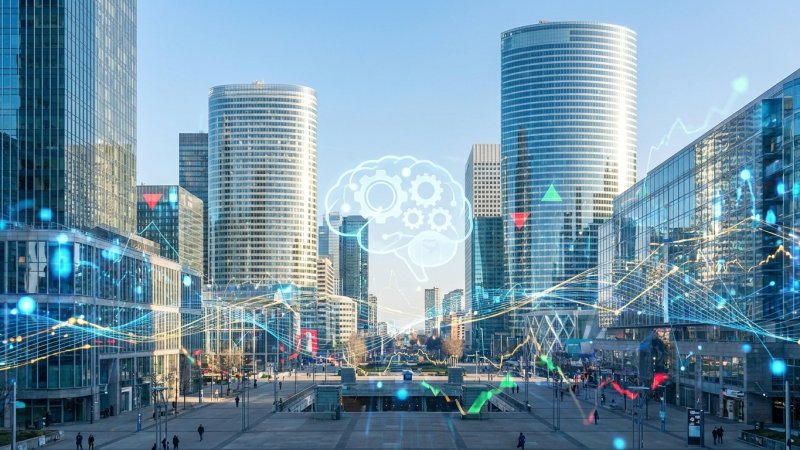
In 2026, artificial intelligence (AI) stands at the forefront of the global economy as both a powerful driver of growth and a notable source of risk. Companies across industries harness AI to gain efficiency, foster innovation, and open new markets, while simultaneously confronting unprecedented challenges regarding data security, workforce adaptation, and regulatory compliance. As AI reshapes the business landscape, stakeholders must navigate the complex balance between opportunity and vulnerability to sustain long-term economic progress.
- AI technologies fuel productivity and innovation for businesses in 2026.
- Regulation and security concerns increasingly affect AI adoption.
- Companies must weigh efficiency gains against new risks and responsibilities.
The Economic Push: AI as a Growth Engine in 2026
Artificial intelligence is no longer a niche technology but a core driver in economic strategies worldwide. In sectors such as manufacturing, finance, healthcare, and logistics, AI-powered systems automate complex activities, streamline supply chains, and accelerate product development. This leads to measurable gains in productivity and cost savings for companies willing to invest in AI-driven transformation.
Businesses with early AI adoption report both increased competitiveness and improved capability to serve customer needs. The agility provided by adaptive algorithms and predictive analytics enables organizations to identify market trends faster than ever before. In financial markets, for instance, algorithmic trading and automated risk assessments reduce human error and foster more resilient portfolios.


Innovation and New Business Models
In 2026, AI spurs the emergence of entirely new business models. Start-ups leverage AI to create data-driven services, ranging from personalized health applications to intelligent logistics platforms. SMEs and larger corporations frequently collaborate with AI-centric vendors, fueling a dynamic innovation ecosystem. Access to vast quantities of structured and unstructured data enables businesses to deploy highly customized offerings, targeting niche customer segments with precision previously unimaginable.
For example, in the context of financing, AI now assists in evaluating start-up viability, accelerating funding decisions. If you want to learn more about these dynamics, see our relevant insights in the article on start-up financing in 2026.
Regulation: The Growing Impact on AI Deployment
Regulatory frameworks have become more robust by 2026, as governments and industry bodies recognize the societal impact of widespread AI deployment. European regulations such as the NIS directive and its successors enforce stringent standards for cybersecurity and data protection. Companies operating in highly regulated sectors must develop compliance strategies to mitigate reputational and financial risk. For details on regulatory impact, our coverage on the NIS Directive in Austria is particularly informative.
Compliance demands ongoing investment in secure infrastructure, comprehensive audit trails, and regular employee training. Organizations that fail to anticipate regulatory changes may face operational disruptions or significant penalties. Legal teams and IT specialists thus play increasingly central roles in AI project management.
Security Risks and Data Vulnerabilities
As AI systems integrate deeply into business processes, their attack surface expands. New forms of cyber threats materialize, ranging from adversarial attacks against machine learning models to large-scale data breaches exploiting automated systems. The risk landscape in 2026 underscores the necessity for resilient cybersecurity frameworks and proactive incident response planning.
For companies, effective AI governance is essential: clear protocols for dataset curation, model explainability, and breach response reduce potential exposure. Compliance with NIS2 and other directives is no longer optional. Dive deeper into these evolving obligations with our article on NIS2 in Austria.
Workforce Transformation and the Talent Gap
The rapid deployment of AI shifts demand in the labor market. Roles centered on data analysis, AI ethics, and algorithmic auditing emerge as crucial, while traditional repetitive tasks experience further automation. This transition fuels an ongoing debate over reskilling initiatives and the potential for structural unemployment in certain sectors.
Companies that proactively address workforce transformation—through targeted training, internal mobility, and partnerships with educational institutions—are better positioned to harness AI's benefits. To inform your HR strategy, read our analysis of the skills shortage in Germany in 2026.
Balancing Benefits and Risks: Strategic Approaches for 2026
Navigating the dual nature of AI requires integrated risk management. Business leaders must assess not only the technical feasibility of AI projects but also the potential for unintended consequences and reputational impacts. Cross-functional committees, external audits, and transparent stakeholder communication become best practices in managing AI-driven transformation responsibly.
In parallel, thought leaders challenge organizations to embrace an ethical AI framework. Aligning innovation with societal values and customer trust will distinguish market leaders in the current competitive landscape. The focus has shifted from mere technical advancement to holistic value creation—balancing productivity gains with underlying risks.
Looking Ahead: The Future of AI in Business and Society
In summary, artificial intelligence in 2026 acts both as a catalyst for economic dynamism and as a complex risk factor that demands vigilant oversight. The companies best equipped to leverage AI are those willing to invest in resilient governance, adaptive workforce strategies, and transparent stakeholder engagement.
As the pace of innovation accelerates, a key question remains: how can organizations continue to harvest the economic fruits of AI while proactively managing the shadow of emerging risks? Exploring this balance will chart the course for sustainable growth in the years ahead.